
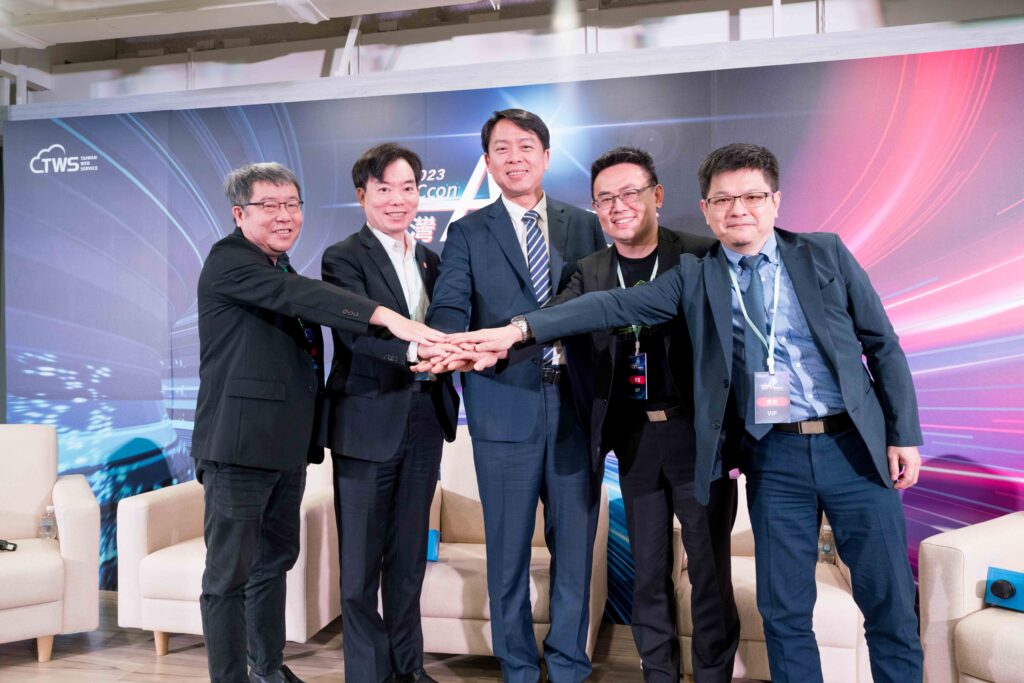
Huang Yi-ping, Vice President of DIGITIMES (from left), Tsai Chi-yen, Chief Information Officer of Taiwan Mobile, Wu Han-chang, General Manager of ASUS Cloud and Taiwan Smart Cloud, Hsiao Yi-chi, Business Assistant of NVIDIA, and Hsiao Yu-chung, Vice President of E-Blue Information, attended the "AIHPCcon Taiwan AI Supercomputing Conference" held by Taiwan Smart Cloud in the morning. They had a lively discussion on "AI 2.0 Driving a New Revolution in the Industry Chain and the Development of the Ecosystem"..
The ChatGPT wave has swept the globe, not only ushering in the AI 2.0 era but also driving the vigorous development of generative AI. In early 2023, Taizhi Cloud, based on AIHPC high-speed computing, created Taiwan's first enterprise-level large-scale language model, launched a brand-new business model, and simultaneously built an AI industry ecosystem, fully promoting a new layout for the AI Foundry industry.
To help Taiwanese industries align with international trends, Taiwan AI Cloud hosted the "2023 AIHPCcon Taiwan AI Supercomputing Conference" on May 17th, themed "AI 2.0 · Supercomputing · New Ecosystem." In addition to showcasing the Formosa Foundation Model (FFM), the conference invited several AI 2.0 partners to share industry trends and applications, working together to create a trustworthy AI 2.0 environment. This technology event attracted numerous professionals who hoped to gain insights into AI digital development trends.
ASUS Chairman Jonney Shih pointed out that ASUS partnered with NVIDIA in 2018 to participate in the Taiwan Supercomputing Center Project 2, and established TaiwanAI Cloud in 2021, becoming the only cloud service provider in Asia offering commercial AI supercomputing services. The Formosa Big Model is Taiwan's first large language model (LLM) on par with OpenAI GPT3.5, significantly enhancing Taiwan's local knowledge capabilities. It accelerates enterprises' entry into the AI 2.0 era by providing large clients with flexible, secure, and convenient enterprise-level generative AI solutions. TaiwanAI Cloud will further actively build computing power, create platforms, and connect with more industry partners to co-create a new AI 2.0 ecosystem.
Former Minister of Science and Technology Chen Liang-chi stated that when the Ministry of Science and Technology promoted the AI industry in 2017, ASUS was one of the earliest companies to step forward and provide support. At that time, the Taiwan Sugi-2 was the world's first high-speed computing platform tailored for AI applications, ranking among the top 20 globally that year, and among the top ten globally in green energy. Taiwan Smart Cloud's transformation of computing power into commercial services is a significant milestone in promoting AI computing power services. The computing power industry represents the future development trend of AI, making ASUS's future performance highly anticipated.
Lee Shih-kuang, chairman of the Taiwan Cloud IoT Industry Association, said that when ASUS decided to participate in the Taiwan Sugi Cloud Infrastructure Project in 2018, it greatly surprised the industry. When ChatGPT was launched at the end of 2022, all parties believed that Taiwan needed a trustworthy large language model and generative AI, as well as a cloud platform with sufficient computing power. Taiwan AI Cloud has achieved both of these things, and it is expected to inject new energy into the development of Taiwan's AI industry.
"With the AI trend firmly established, generative AI and cloud services are two indispensable tools for companies to enhance their competitiveness in the market today." Chiu Li-meng, NVIDIA's Global Vice President and General Manager of Taiwan, believes that "ASUS's integration of these two tools is expected to drive the vigorous development of Taiwan's industries and demonstrate its strong strength to the world."
Taizhiyun's enterprise-grade large-scale language model has been launched, ushering in a new AI 2.0 ecosystem.
Following the global surge of ChatGPT, Taizhi Cloud visited over a hundred institutions worldwide to conduct in-depth research on the characteristics and applications of generative AI models. They discovered that the benefits of this AI architecture for businesses extend beyond text and image recognition, and can be further applied to high-value tasks such as prediction and recommendation, bringing diverse potential benefits across numerous areas. Recognizing that Taiwanese businesses desired a reliable and usable generative AI model, Taizhi Cloud, based on the Taiwan Sugi-2 mainframe, utilized a 768-GPU, AIHPC supercomputing environment to train a large language model, launching Taiwan's first large language model—the Formosa Large Model—allowing Taiwanese industries to enjoy localized generative AI services.
Wu Hanzhang, General Manager of Huaduan Cloud and Taizhi Cloud, pointed out that the Formosa Big Model is the pre-trained model that best understands Taiwan. We have particularly strengthened the training in Traditional Chinese, making it closer to Taiwanese terminology and knowledge, and also supporting multiple languages. Its overall performance is close to ChatGPT3.5, but it has the advantage of more recent data. After the official launch of the Formosa Big Model, two data volume models, 176B and 7B, will be provided, along with background environments for enterprises to test and choose the most suitable data volume solution.
Enterprise-grade generative AI solutions leverage the large-scale models of Formosa and offer a series of AFS (AI Foundry Service) services, including AFS Platform (large-scale language model optimization service), AFS Shuttle (large-scale language model optimization sharing service), AFS Appliance (large-scale language model on-premises deployment solution), and AFS Cloud (large-scale language model hosting service), enabling enterprises to best implement AI 2.0 application scenarios.
With the advent of the AI 2.0 era, the importance of FFM is increasing daily.
In the symposium "AI 2.0 Driving a New Revolution in the Industrial Chain and the Development of the Ecosystem," moderated by Huang Yiping, Vice General Manager of DIGITIMES, he stated that under the wave of generative AI, from OpenAI, Microsoft, and Google to Baidu's Wenxin Yiyan in China, large-scale language models have become a prominent field of competition in the US and China. Taiwan Zhizhi Cloud's launch of Taiwan's first enterprise-level large-scale language model—Formosa Large Model—marks Taiwan's official entry into the AI 2.0 field, giving various industries the opportunity to strengthen their competitiveness on the international stage through the assistance of generative AI and large-scale language models.
Wu Hanzhang stated that AI 2.0 is bringing about a brand-new ecosystem for supercomputing, signifying the arrival of the Moore's Law era for artificial intelligence systems and promising to create more innovative applications centered around AI 2.0 technology. Taizhi Cloud focuses on the field of AI supercomputing services, and its AIHPC as a Service allows customers to experience and utilize AIHPC resources through cloud services, making it the best partner for Taiwanese industries to apply core AI 2.0 technologies.
Taiwan Mobile's Chief Information Officer, Tsai Chi-yen, pointed out that if companies want to use AI to create business value, they should expand the scope of AI technology use among employees, build AI engines into applications, invest in large language model research, and take cybersecurity issues into consideration.
"Amid the wave of generative AI, we have observed that various industries are eager to adopt this technology to create more diversified application services," explained Hsiao Yi-chi, Business Associate at NVIDIA. "Taiwan's Formosa Big Model lowers the barrier for enterprises to adopt generative AI, and is expected to create more diverse application scenarios."
Hsiao Yu-chung, Vice President of Ilan Information, said, "We have been waiting for this moment for 20 years. Ilan has a large database, and our customers are looking forward to automatic best answer provision, the introduction of generative AI, and even full-process AI solutions. We will also work closely with Taizhi Cloud to provide better intelligent data services."
Many AI 2.0 partners also shared and showcased the latest developments and solutions for AI smart applications, such as precision medicine, digital twins, smart manufacturing, smart transportation, and smart commerce. They shared how to utilize the latest digital technologies and computing power to meet the AI scenarios and applications of various industries, thus fully outlining the development blueprint for the AI 2.0 era.
[Article excerpted from]DIGITIMES】