
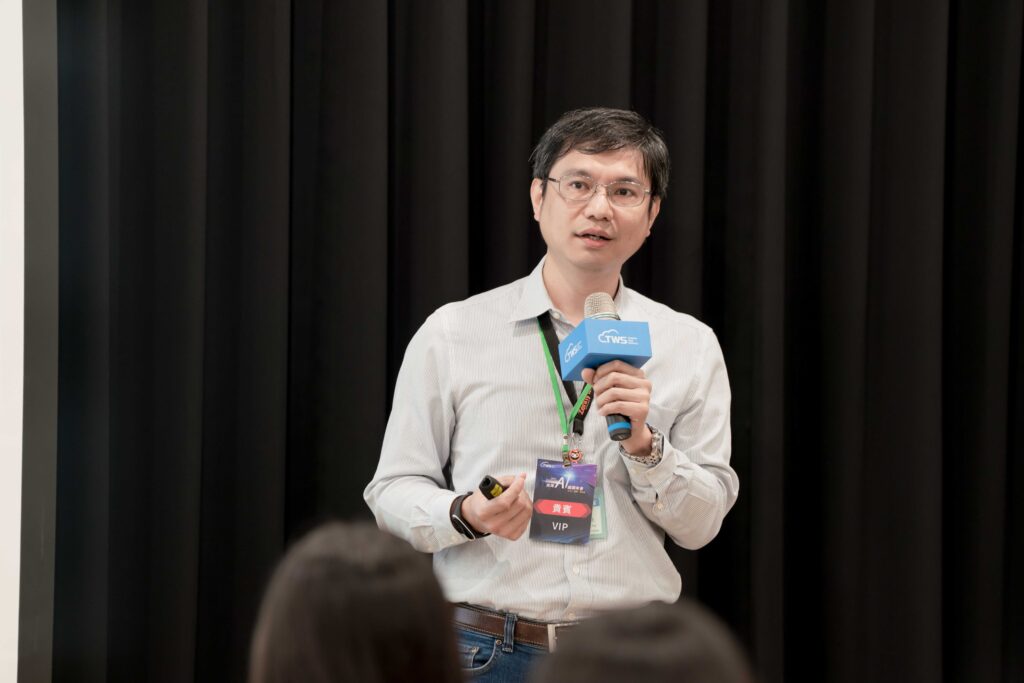
At the AIHPCcon Taiwan AI Supercomputing Conference, ASUS Product Director Shih-Yao Tai delivered a speech titled "OneGenome – Equipping Precision Health with a Warp Drive.".
With the continuous advancement of medical technology, precision health has become a widely discussed and popular application. According to the National Development Council, precision health is based on individual genotypes, or differences in gene expression, environment, lifestyle, and the molecular basis of diseases, in order to accurately predict, prevent, diagnose, and treat diseases.
The viability of precision health technology hinges on robust computing power. Taizhi Cloud AIHPC, ranked among the top 20 global computing power providers in 2018, can provide a powerful engine for precision health, acting as the best partner in driving the development of the healthcare industry.
ASUS Product Director, Shih-Yao Tai, pointed out that Taisun AIHPC boasts a computing power of up to 9+ PFLOPS, improving deep learning efficiency by 498 times and increasing image interpretation accuracy by 231 TP3T. Our AIHPC engine utilizes numerous NVIDIA GPU chips and incorporates the NVIDIA Clara Parabricks genomics toolkit, supporting GPU-accelerated computing. This accelerates genomics sequencing analysis by more than 80 times compared to CPU-only solutions, while reducing computational costs by up to 501 TP3T.
Digital twins have a wide range of applications and outline a blueprint for smart city development.
With the rapid advancement of AI technology, the application scope of Digital Twin technology is expanding. This technology can create a highly accurate and real-time digital model reference for physical entities in virtual space. Simply put, it uses connected sensors on physical entities to collect data from physical devices, scenes, etc., and synchronously maps this data onto the virtual model while conforming to real physical conditions and obeying physical laws, achieving perfect synchronization with reality. Currently, Digital Twin technology has become an important tool for planning digital city scenarios. For example, in 2019, Singapore and Dassault Systèmes of France used this technology to showcase a blueprint for future urban governance. Japan and the United Kingdom have also proposed similar applications, and the Transportation Research Institute of Taiwan's Ministry of Transportation and Communications has also used it to showcase the research results of related projects.
Wu Chia-Lung, Senior Manager at ASUS Cloud, stated that in the past, creating digital virtual images of cities required a foundation of satellite photographs, map surveying, and BIM (Building Information Management System) models, which were then used to create 3D models. Now, through AI-driven digital twin technology, powered by a new simulation engine and coupled with a massive, highly realistic 3D scene database, complex scene modeling can be easily accomplished. Furthermore, ASUS WebStorage, combined with ASUS Cloud's AI True Cloud platform, fully leverages ASUS's high-speed computing capabilities and its proprietary cloud service platform, making it the perfect combination for developing digital cities.
"Digital twin technology can reduce the cost of testing and simulation in the real world, as well as retrieve data that is rare or unavailable in the real world, making it an important technology for developing smart cities," explained Lee Tsung-chieh, manager of ASUS Computer. "Taking open-field roadside parking management as an example, training and validating AI models requires collecting a large number of license plate photos, including different shooting angles, lighting colors, and weather conditions, which is quite labor-intensive and resource-intensive. After building a digital twin, through data generation technology, not only can various types of license plates be collected comprehensively, but the time required for data annotation is also saved. Finally, after applying a highly adaptable roadside parking management AI model, human error can be greatly reduced, and accurate billing can be performed for each vehicle, realizing a user-pays scenario and gradually improving the development vision of smart cities."
Regarding generative AI, Tsai Yi-hsiu, deputy director of Taiwan Mobile, pointed out that after using the Taizhi Cloud Big Language Model to optimize customer service Xiaomai, they realized that when applying the Big Language Model to projects, it is necessary to accurately determine the application goals in order to delve deeper into the application scenarios and find pain points.
Chang Sen-Chia of the Industrial Technology Research Institute's (ITRI) ICT Research Laboratories pointed out that generative AI can improve the quality of medical services, reduce care costs, and provide empowering services through user-friendly interactive interfaces, bringing significant benefits to both healthcare providers and those being cared for. Given that National Health Insurance expenditures reached approximately NT$700 billion in 2020, it is estimated that by leveraging technology, savings of NT$10% could be achieved by 2030.
[Article excerpted from]DIGITIMES】