
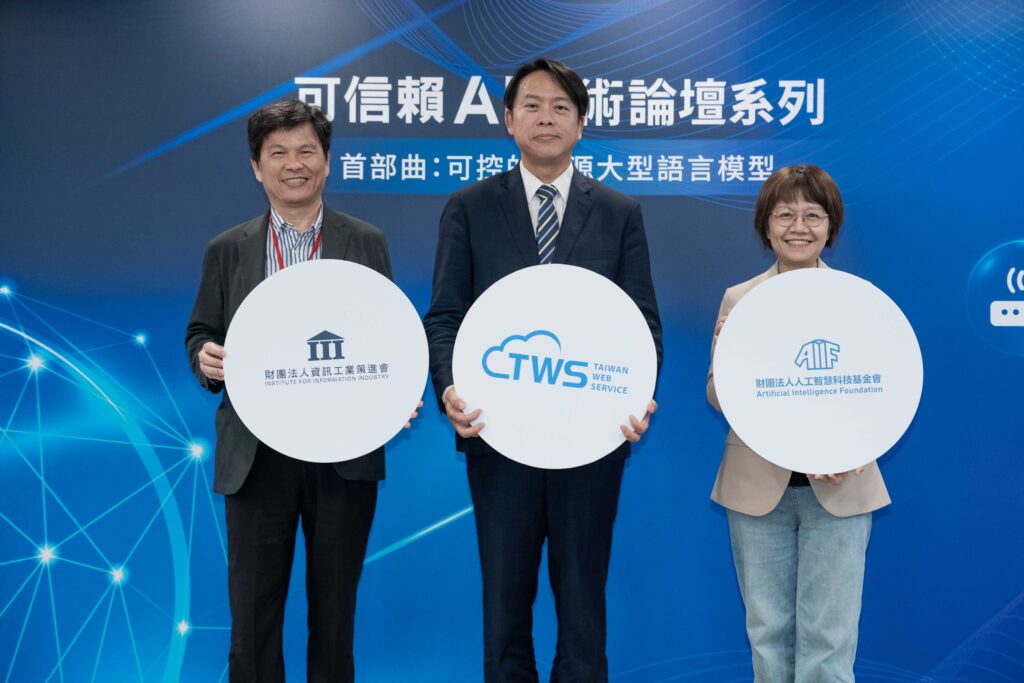
Yang Renda (from left), Deputy Executive Director of the Institute for Information Industry, Wu Hanzhang, General Manager of ASUS Cloud and Taizhi Cloud, and Wen Yiling, Executive Director of the Artificial Intelligence Technology Foundation, attended and supported the "Trustworthy AI Technology Forum Series". The first part of the series focused on "Controllable Open Source Large Language Models" and featured exciting sharing.
Taizhi Cloud is hosting the "Trustworthy AI Technology Forum Series" to provide enterprises with secure, highly flexible, efficient, and economically autonomous generative AI development solutions. The first installment on September 21st focuses on "Controllable Open-Source Large Language Models," inviting experts to share the latest trends in generative AI and the technological and application benefits of open-source large language models. On the same day, the world's first Traditional Chinese optimized version of the FFM-Llama 2 open-source model will be released, and five themed booths will be showcased, creating a trustworthy, controllable, and inclusive generative AI ecosystem.
Among the five themed booths are the world's first fully optimized "FFM-Llama 2 (70B/13B/7B) series" and a variety of reliable open-source models for enterprise-grade generative AI services, providing enterprises with autonomy over LLM (Large Language Model). To meet the needs of various application scenarios, Taizhi Cloud has also integrated multiple models into "Four Generative AI Development Products".
In addition, ASUS launched a "Private Cloud Ground Deployment Solution" that balances cybersecurity and hardware/software integration, ranging from ASUS ground GPU Servers to placing LLM on "AI PCs" using GPTQ 4-bit high-performance compression technology. The "Code Llama" open-source model was also integrated into AFS (AI Foundry Service) to provide developers with a better working environment. Furthermore, ASUS showcased the advantages of combining cloud storage and LLM in its cloud solutions, creating a "second brain xBrain" to help enterprises accelerate productivity and optimize work patterns.

Wu Hanzhang, General Manager of ASUS Cloud and Taizhi Cloud, stated that Taizhi Cloud provides large language models and tool platforms in an open model, significantly reducing the entry barrier for enterprises and realizing inclusive AI and developing human-centered smart technology.
ASUS Cloud and Taisun General Manager Wu Hanzhang stated that amidst the global AI wave, while accelerating enterprise initiatives towards "trustworthy AI," "inclusive AI," and "sustainable AI," we have been continuously exploring more innovative cloud services. In 2023, we launched Taiwan's first Formosa Foundation Model (FFM), enabling Taiwanese enterprises to enjoy the various advantages of large language models. In addition to promoting LLM applications, we continue to expand the FFM open-source model, hoping to attract more partners to join us.
Yang Renda, Deputy Executive Director of the Institute for Information Industry (III), stated that AI is evolving rapidly, with increasingly widespread and in-depth applications. The key to a company's success in implementing AI lies in its core model; if the wrong model is chosen, the entire process may have to be restarted. Each company has vastly different data and needs, making it extremely difficult to independently implement and train an AI model. This necessitates the assistance of external expert teams. Taizhi Cloud is the only provider of LLM models in Taiwan, making it the best partner for companies implementing generative AI.
Wen Yi-ling, CEO of the Artificial Intelligence Technology Foundation, stated that in 2021, the integration of AI and cybersecurity technologies strengthened the ability to detect malicious threats. AI is now ubiquitous in daily life, making the issue of trustworthy AI a major concern. Taiwan possesses an advantage in international trust and should leverage this advantage to establish a dialogue and sharing mechanism to demonstrate its strong capabilities in the AI field. The foundation will continue to work closely with Taiwan AI Cloud to build a trustworthy AI ecosystem in Taiwan.
Open source LLM offers numerous advantages, making it the preferred choice for trustworthy AI.
The combination of generative AI and the powerful capabilities of LLM has made "trustworthy AI" a focal point. With an increasing number of open-source LLM models available, enterprises can expect advantages such as "data privacy and cost savings," "security," "task focus," and "code transparency," all backed by a large and active development community, eliminating concerns about being tied to commercial LLM models.
Therefore, after releasing its first FFM, Taizhi Cloud has continued to import open-source large language models to provide enterprises with more diverse choices. For example, in the AFS pre-trained model library, in addition to the original FFM-Bloom, open-source models such as FFM-Llama 2, Embedding and the native Meta Llama 2 have been added.
Wu Hanzhang stated that the newly launched Traditional Chinese optimized FFM-Llama 2 (70B/13B/7B) series allows enterprises to easily improve work efficiency by selecting the appropriate model type based on application scenarios and budgets. In the future, Taizhi Cloud will also gradually launch basic models and model compression functions developed with more partners, providing enterprises with diversified AI services.
Liu Wenshan, deputy director of the AI Engineering Technology Center at the Institute for Information Industry's Software Research Institute, explained: "It is recommended to adopt the 80/20 rule in the process of introducing generative AI. 80% of the simple routine tasks can be completed by AI, while 20% of the complex tasks can be performed by humans. This will help accumulate cases and data to prepare for the next stage."
Tsai Yuan-hong, chief data scientist at the Artificial Intelligence Technology Foundation, pointed out that since the advent of LLM, it has been reshaping the way we work and the application model of AI, fundamentally changing to human-machine collaboration and improving efficiency. Enterprises should carefully consider the direction of subsequent implementation and application.
Trustworthy AI gains attention; open-source LLM meets enterprise expectations.
OpenAI, which rose to fame with ChatGPT, has its most well-known LLM product. However, thanks to the efforts of various organizations and the open-source community around the world, there are also open-source LLMs such as BLOOM and Llama 2 with comparable functionality. In addition to meeting the needs of commercial applications, open-source LLMs also give enterprises autonomy over their models and the flexibility to deploy them on-premises or in the cloud.
Chen Zhongcheng, CTO of Taizhiyun, stated that Meta Llama 2 is comparable to ChatGPT 3.5, but its Traditional Chinese capabilities are not ideal. Taizhiyun's Traditional Chinese optimized FFM-Llama 2 retains the excellent response methods and capabilities of the original Llama 2, while also allowing businesses to enjoy the advantages of answering questions in Chinese. The multiple models available for businesses to choose from meet different needs such as natural language processing, text generation, and code generation.
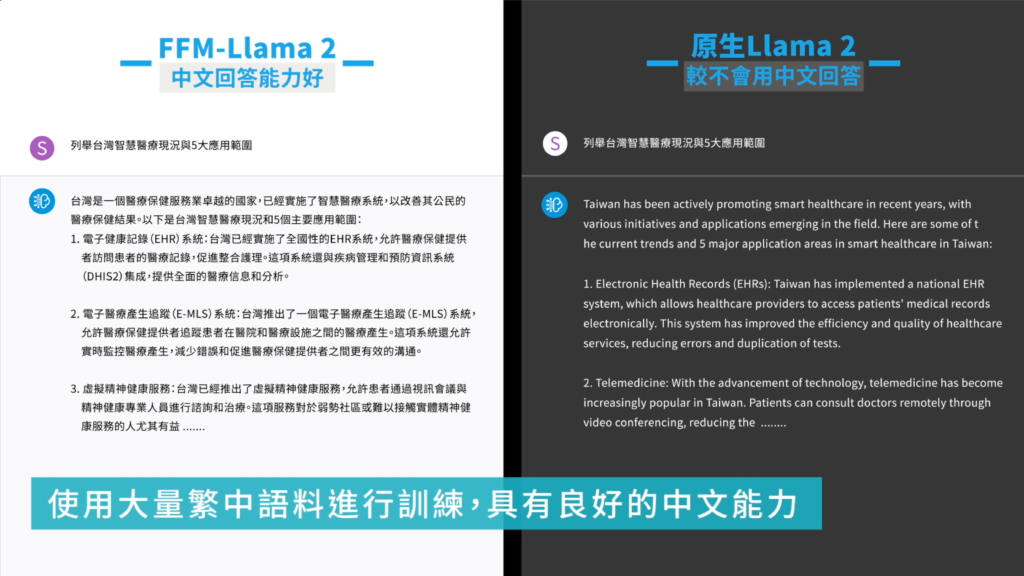
Taizhi Cloud has launched the world's first Traditional Chinese FFM-Llama 2 language model, which retains the excellent dialogue quality of the original Llama 2 and uses localized Chinese for accurate expression.
Taizhiyun's enterprise-level generative AI solution, designed to address manpower and resource shortages, is highly anticipated.
Given the shortage of AI talent and limited resources, it is extremely difficult for enterprises to build their own AI models. To address this, Taizhi Cloud, leveraging its powerful AIHPC computing capabilities, has launched the market-leading AFS one-stop solution to help enterprises train, adjust, and build their own LLMs at any time. Enterprises can use the AFS Platform to fine-tune their proprietary knowledge to generate custom models. After training, these models can be directly deployed to the AFS Cloud for cloud-based inference services, or the AFS Appliance can be placed in their own on-site data center.
Taizhiyun's Chief Engineer, Zhao Fengyi, pointed out that Taizhiyun's FFM Llama 2-7B models perform well in specific domains, while 13B can generate knowledge insights, making it suitable for ground-based inference and applications. As for FFM Bloom-70B and 176B, they possess cross-language capabilities and multilingual backgrounds, enabling them to meet various downstream tasks for new application opportunities.
In response to the strong market demand for generative AI, Taizhi Cloud's four generative AI services—CCS, AFS, HPC, and OneAI—are the best and most reliable AI partners for enterprise generative AI innovation.
[Source:]DIGITIMES】