
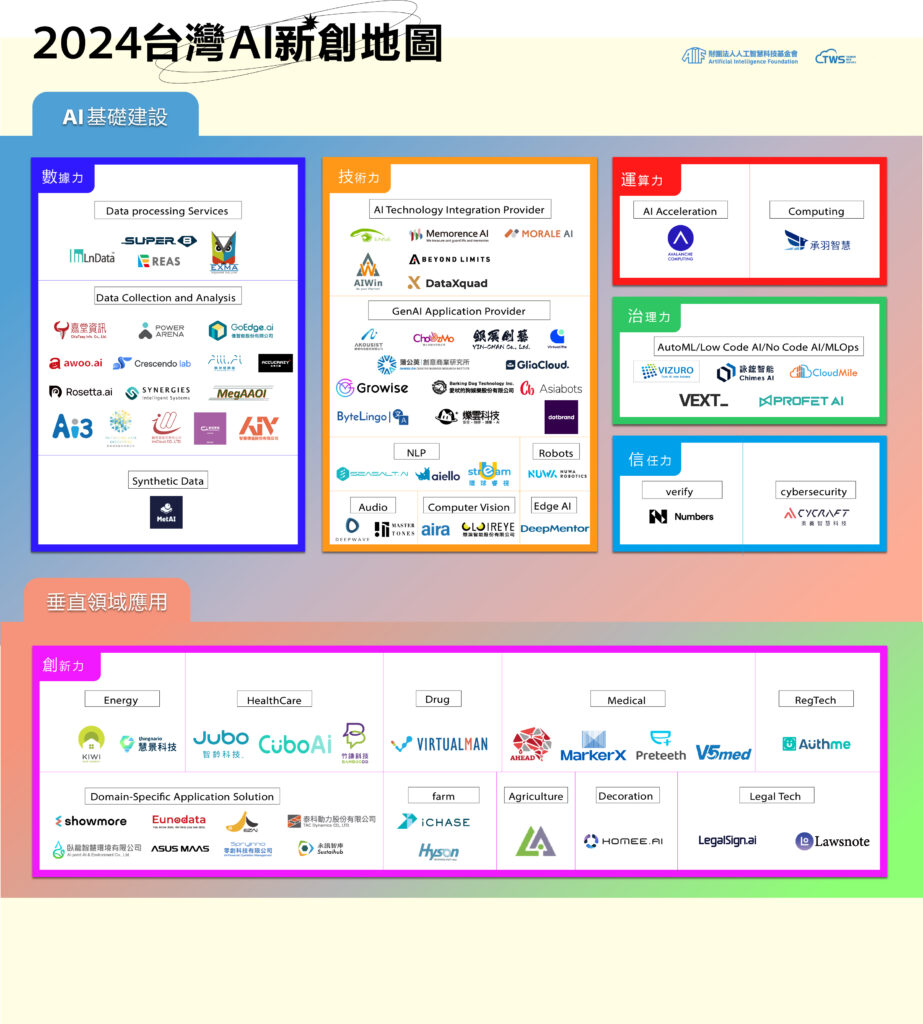
▲The Artificial Intelligence Foundation (AIF) and Taizhiyun AI Supercomputing Accelerator have collaborated to release the "Taiwan's AI Startup Map 2024". This map primarily lists startups established within the last eight years and categorizes them based on the infrastructure and vertical industry applications required for AI implementation. Companies can find partners based on their own needs.
How can companies collaborate with external teams to add dynamism?
"Lack of data" and "lack of talent" have always been the biggest hurdles for Taiwanese companies adopting AI, regardless of industry or company size, with almost no exceptions. If a company lacks the capacity to build its own technical team, seeking assistance from external teams is a good approach. Since different AI technology fields specialize in solving different problems, companies can match the most suitable technology partners according to their own needs.
However, in our experience creating AI ecosystem maps over the past few years, we've also observed that many Taiwanese startups, while possessing technological capabilities and service systems, and even accumulating numerous practical cases, often lack actual products. Project-oriented and product-centric thinking represent two different business models: the former emphasizes customized solutions, while the latter focuses on building replicable and scalable business models. We recommend that teams, while focusing on technology and services, should more clearly define how to transform project results into products with market potential, thereby achieving long-term value and scalable development.
Within this industry context, SaaS (Software as a Service) companies are expected to play an increasingly crucial role. These companies provide ready-to-use AI solutions, significantly lowering the technical barriers and initial investment costs for businesses adopting AI. WinHub.AI, selected as a rising star, is a fusion AI SaaS platform solution that provides clients with large language models, computer vision, data analysis (AutoML), expert systems, and traditional algorithms. It enables clients to develop and use the AI models they need, allowing users to directly apply AI tools based on industry knowledge, reducing the need for software engineers and data scientists. This approach of lowering the barriers to entry offers a viable solution to the talent shortage problem.
In terms of governance, in addition to risk management that needs to be considered in AI applications, issues such as organizational management are also included. Enterprises must be able to integrate technology, computing, and data to complete the AI infrastructure. Platforms such as AutoML, NoCode, and MLOps are all auxiliary functions, and enterprises still need to rely on their own governance capabilities.
After completing their basic capabilities, companies can leverage AI to improve and solidify their core competencies and unique resources that competitors cannot replicate, thereby continuously strengthening their competitiveness. This is what innovation focuses on. In this map, some startups have also developed industry-specific solutions by combining their existing domain knowledge with AI technology. Examples include Wolong Smart Environment, which provides solutions to unstable water quality, increases water recycling rates, and promotes energy conservation and carbon reduction; and Haisheng Technology, which assists aquaculture farmers in monitoring fish and shrimp.
We have also found that, apart from industries with relatively fixed environments such as manufacturing and healthcare, the inability to find the best application scenarios for AI is a challenge that startups have always faced.
Why is Taiwan's industrial AI development progressing slower than expected? Former Google Taiwan Managing Director Chien Li-feng believes that besides insufficient market size and the inadequate digitalization of most companies, a lack of imagination is a pressing issue. For example, despite being one of the few places in the world where drones can be manufactured, and located in an earthquake-prone region, Taiwan still needed Turkey's assistance in creating 3D models using drones during an earthquake, clearly demonstrating a lack of imagination regarding applications.
Beyond computing power, there are many other challenges in applying sovereign AI, including ensuring the quality of Traditional Chinese models and encouraging companies to share training data to improve together. In terms of computing power, energy-saving technologies could potentially maintain an advantage. Regarding talent, in addition to cultivating basic modeling talent, could international collaboration be strengthened? Finally, how can the government leverage its chip advantage to acquire key technologies and improve the quality of Traditional Chinese models through cross-border platform cooperation? These are all areas where the government can contribute.
At the same time, we have also observed several key points and trends that are worth sharing with you:
I. Cybersecurity challenges remain a key concern for enterprises in the application of generative AI technology.
The emergence of generative AI helps us quickly learn knowledge in various fields, making knowledge that was previously considered "specialized" easier to understand and apply.
In this ecosystem map survey, we again asked startups that provide AI services or products: "Has the generative AI boom impacted your business?" Most companies indicated that this AI boom has brought significant benefits to startups: not only has it greatly increased their exposure and service opportunities, but more importantly, the public's understanding of artificial intelligence has gradually deepened, effectively reducing communication costs between businesses and customers.
More and more generative AI application services are being developed. Some of these services are extensions of existing products, attempting to lower the barrier for users to use them; however, others simply use Prompt technology to connect API functions to create conversational robots, providing question-and-answer services or different interfaces. If such services lack core competitive advantages, they often need to be aware of the risk of being replaced by large platforms such as ChatGPT.
It's worth noting that cybersecurity is a primary consideration for businesses when adopting AI. According to an AIF survey on AI adoption in Taiwan's industries released in early 2024, a staggering 27.11 companies (TP3T) were most concerned about potential data breaches when evaluating AI applications. This not only highlights a shortage of technical talent but also reflects the cautious attitude of businesses towards AI applications.
II. How software can combine hardware advantages to find unique applications
At the 2024 National Ding Forum on June 26th, Chien Li-feng also mentioned four major technological development directions that need attention in the future: model polarization, cloud services + AI, the new battlefield of Edge AI, and the resurgence of robotics. The latter two represent opportunities for Taiwan. This is because when there is an AI usage environment on the terminal, related applications can be developed.
He cautioned that while Taiwan excels in hardware, it should also invest resources in exploring how to apply AI, especially with the emergence of Edge AI. What can Taiwan do with it? For example, what about robotic arms, bicycles, or any hardware with AI added? Chien Li-feng believes that although Taiwan is a little late to the game, it's not too late. The global cryptocurrency market has only been around for a little over a year, so Taiwan can allocate some of the profits from selling shovels to mining. Otherwise, the industry will become too concentrated and may end up competing with itself.
III. Enabling AI to Learn Spatial Intelligence to Perceive the World
In April 2024, Dr. Fei-Fei Li, a professor at Stanford University, introduced the AI development direction of the startup World Labs at the TED conference in Vancouver: "Spatial Intelligence". This is not only an advanced development of computer vision technology, but also represents a major leap forward in the interaction between AI and the real world.
Li Feifei stated, "Spatial intelligence empowers machines not only to interact with each other, but also to engage in deep dialogue with humans and the three-dimensional world, whether in the real or virtual space." She used a photo of a cat about to spill milk to explain the concept of spatial intelligence. Humans can immediately know what is about to happen and what action to take by using visual information in the photo, such as the positions of the cat, the table, and the cup, and their relative relationships.
Stanford University's research also demonstrates the practical application potential of spatial intelligence. For example, AI can generate three-dimensional 3D models from flat photos, and can detect whether medical staff are following cleaning procedures and whether patients are at risk of falling. These applications provide a broad prospect for spatial intelligence in various fields.
IV. Will AI Agents Be the Future?
Landing AI founder Andrew Ng has repeatedly mentioned that AI Agent is one of the most noteworthy AI trends in 2024. Whether for consumers (2C) or businesses (2B), AI Agent services are already taking shape.
There is currently no universally accepted and clearly defined definition of AI agents. A common definition is a system that can understand its surroundings, learn from them, and interact intelligently to solve problems. The importance of AI agent technology lies in its ability to autonomously perform complex tasks, reducing human intervention and significantly decreasing human error while improving efficiency. These agents can make decisions according to predetermined goals and learn and adapt to changing environments. Applications include automated customer service, recommendation systems, and smart homes. However, challenges also arise, particularly in the areas of ethics and privacy, including the possibility that autonomous decision-making may lead to unintended consequences or even security issues. Ensuring transparency, fairness, and controllability will be crucial for the future.
In the face of a rapidly changing industrial environment, while startups accumulate talent and capabilities, aligning with industry needs will be both an opportunity and a challenge. AIF, with its mission to promote the AI transformation of industries, has actively promoted numerous initiatives over the years to gain a deep understanding of enterprise needs, aiming to empower them with AI capabilities and actively build exchange platforms among industry, government, academia, and research institutions to enhance Taiwan's industrial competitiveness.
Taizhiyun's AI Supercomputing Accelerator focuses on providing comprehensive business development resources and technical support for AI startups. Taizhiyun has taken the lead globally by launching the AI Foundry Service (AFS), a generative AI outsourcing service. This provides startups with the latest AI model applications, the Formosa Foundation Model, and AI computing power deployment services, creating a highly secure and efficient one-stop AI solution. It assists startups in developing AI technologies, products, and market applications, aiming to become a key platform for accelerating the commercialization of AI startups.
▚ Source:Know the situation