
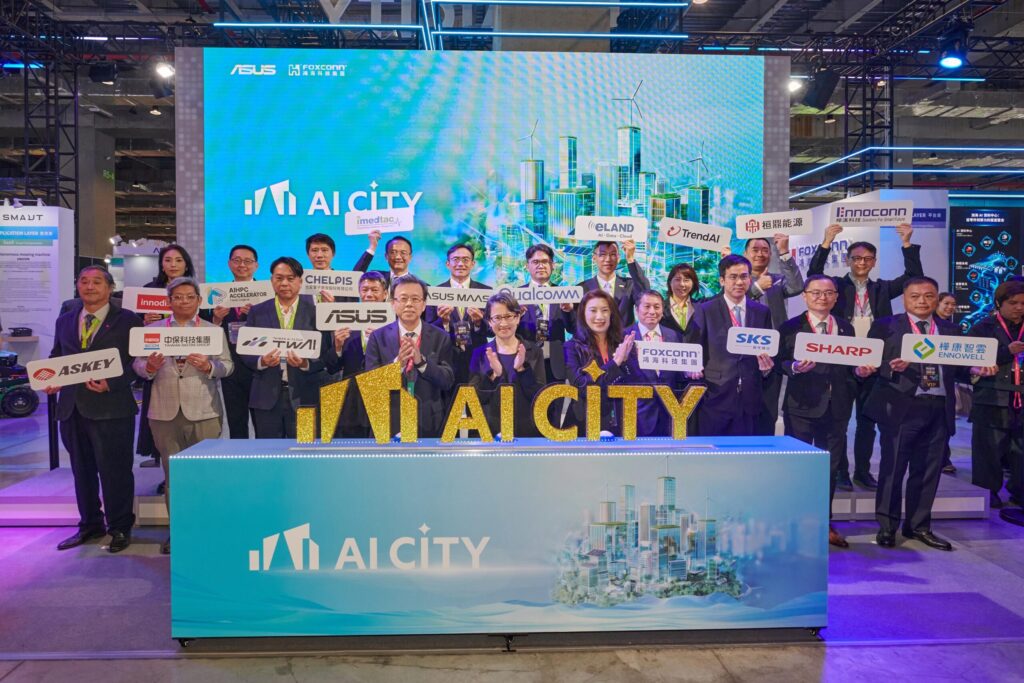
▲ At the 2026 Smart City Expo & Net Zero City Expo, ASUS integrated its group resources and joined hands with Foxconn and partners of the Taiwan Smart City Solutions Alliance to create a replicable "whole city output" model, helping cities to more confidently move into the AI era. (First row, from left: ASUS Co-CEO and Chairman of the Taiwan Smart City Solutions Alliance, Samson Hu; Vice President Louise Hsiao; Foxconn Group Rotating CEO Kathy Yang)
The "2026 Smart City Expo & Net Zero City Expo" was launched today (17th). ASUS Group, with "AI City" as its core strategy, brought together solutions from various companies in smart cities, smart transportation, smart healthcare, smart security, and sustainable governance. Through the five-layer "AI City Architecture"—from sovereign computing power, sovereign models, platforms, applications to the innovation layer—and combined with the industry ecosystem, it fully outlined a blueprint for a sustainable and scalable AI City. During the exhibition, partners from many European countries were also invited to Taiwan to jointly showcase their implementation cases, demonstrating ASUS's long-term strategy and determination to deepen its international market layout in collaboration with global partners. The "Maestro Smart Command Center" was also on display, aiming to break down integration barriers. Through seamless connection across brands, vehicles, platforms, and venues, it drives the system to upgrade from "single-domain integration" to "full-domain command," realizing truly autonomous intelligent collaboration.
ASUS Co-CEO and Chairman of the Taiwan Smart City Solutions Alliance, Samson Hu, stated, "ASUS integrates group resources to help cities confidently step into the AI era; at the same time, together with Foxconn and partners of the Taiwan Smart City Solutions Alliance, we are jointly creating a replicable 'whole city output' model, providing a next-generation urban development blueprint that is secure, scalable, and can be implemented globally. We are committed to empowering every human-centered, more resilient, and efficient AI City through sovereign AI."
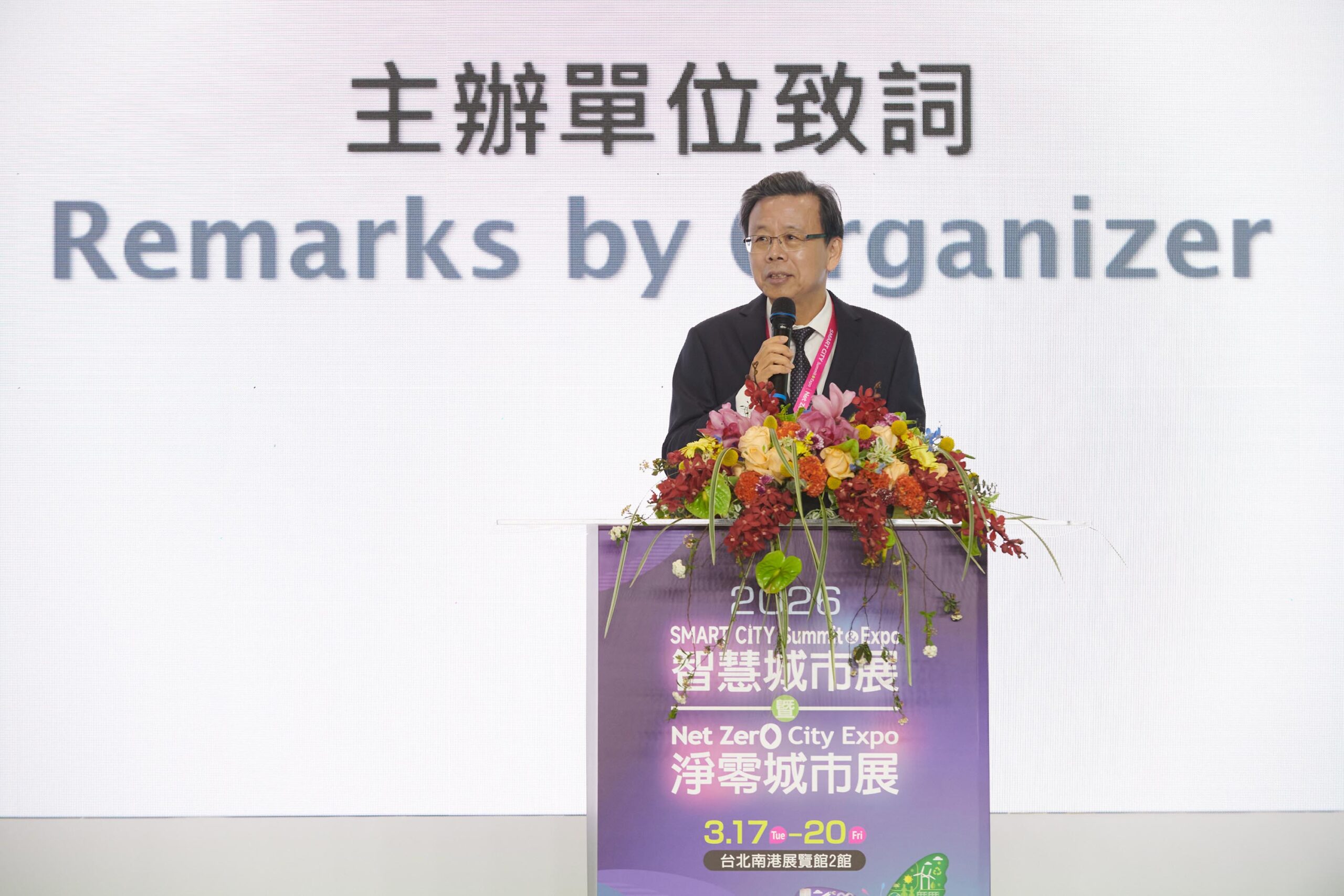
▲ ASUS Co-CEO and Chairman of the Taiwan Smart City Solutions Alliance, Samson Hu, stated that the Taiwan Smart City Solutions Alliance, together with ASUS Group, Foxconn Group, and more than 30 industry partners, has created the AI City themed pavilion with city sovereignty AI as its core.
Five-LayerAI City "Architecture" is moving towards the scalability stage
ASUS Group integrated ASUS AIoT Solution and its subsidiaries Taiwan AI Cloud, ASUS AI Cloud, and ASUS Mobility to showcase the comprehensive layout of AI City in the AI City themed pavilion with a five-layer architecture. It focused on the practical implementation of the "application layer" and emphasized how AI technology can move from architectural design to the city market, from proof of concept (PoC) to scalable deployment.
- Sovereign computing layer:Integrating urban infrastructure construction and operation, data center technology, and edge computing capabilities, it lays the foundation for national-level AI operation.
- Sovereignty Model Layer:Focusing on locally optimized Large Language Model (LLM) and AI model technologies to ensure data sovereignty and application locality.
- Platform layer:It supports diverse urban applications and governance needs through trusted data services and a cross-system platform hub.
- Application layer:With the concept of "National City AI Showcase", it focuses on four core areas: healthcare, transportation, security, and municipal administration, as well as net-zero applications.
- Innovation Layer:Connecting national-level AI resources and industrial ecosystems, such as AI supercomputing accelerators and new applications, to drive long-term innovation momentum.

▲ ASUS Group uses "AI City" as its core strategy, and outlines a blueprint for a sustainable and scalable AI city through a five-layer architecture.
Taiwan AI Cloud with full stack
Capabilities to build urban sovereignty
Infrastructure
In recent years, Taiwan AI Cloud has participated in the construction and operation of multiple AI supercomputing centers and computing power platforms in Taiwan, and has collaborated with the Tainan City Government to promote the AI City demonstration project. Through continuous accumulation of practical results, it has gradually established a complete experience from computing power foundation to urban governance applications, playing a key role in the deployment of AI City projects to the international market. At the exhibition, Taiwan AI Cloud presented a comprehensive solution with "full-stack AI capabilities," providing AI computing power infrastructure, local models and AI platform services, and an innovation accelerator to help cities quickly build scalable AI infrastructure that meets the needs of cybersecurity and local governance.
At the sovereign computing layer, Taiwan AI Cloud showcased its AI computing infrastructure and computing power rental services, with AI Foundry supercomputing capabilities at its core. It integrates high-efficiency AI servers, supercomputing resources, and computing power scheduling platforms to build the AI computing environment required for local deployment, meeting diverse needs such as transportation, energy, public safety, and governance. At the same time, it ensures that data and computing can run securely locally, establishing a sovereign computing foundation for the AI era.
The Sovereignty Model layer showcases the Formosa Foundation Model, which focuses on localized usage scenarios. Through training with local language data and embedding professional knowledge, it creates a smart governance decision-making engine that conforms to the city's cultural context, legal system, and public service needs. It adopts private deployment and a trusted data architecture to ensure that sensitive information does not need to flow across borders, demonstrating that while improving the performance of AI applications, it can also take into account data sovereignty and governance controllability.
At the platform layer, Taiwan AI Cloud showcased its AI Inference Platform, AI Hub, and AI True Cloud Digital Twin Platform, providing AI platform capabilities from model development and inference deployment to integration with urban application scenarios. Through cloud-ground integrated architecture and computing power scheduling mechanisms, cities can rapidly deploy AI applications and build city-level digital twin environments in areas such as smart transportation, public safety, energy management, and citizen services. At the innovation layer, the AIHPC supercomputing accelerator and AI innovation consortium mechanism connect government, enterprises, and AI startups, aiming to promote the AI transformation of urban industries and the incubation of innovative applications.
ASUS Leads the Application Layer in Smart IoT, Deepening International Cooperation
ASUS Smart IoT serves as the central hub for AI City, playing a core role in the "application layer" and encompassing smart healthcare, smart security, and smart transportation. Through integrated hardware and software solutions, it constructs comprehensive AI city applications, focusing on data-driven approaches and cross-system integration to enhance urban efficiency, public safety, and sustainability, showcasing internationally proven results that can be replicated across cities. In smart healthcare, through ASUS xHIS
The next-generation healthcare platform, VivoWatch smart health watch, handheld wireless ultrasound, and health stations help address challenges such as fragmented medical data, insufficient resources in rural areas, and the heavy workload of healthcare workers. Smart security utilizes an AI-powered smart safety system to detect high-risk behaviors and intrusions into dangerous areas through image recognition.
In the area of smart transportation, ASUS is collaborating with partners to develop smart fleet management, computer vision-based curb management, smart logistics and warehousing, and a city-level smart street lighting and infrastructure management platform. ASUS Group's subsidiary, Asus Automotive, is implementing smart traffic control and vehicle-to-infrastructure (V2I) applications through smart bus stops, smart shelters, smart shared poles, and 5G private networks, while expanding into urban application scenarios. ASUS Mobility focuses on AI-powered smart parking, launching solutions such as AI dual-mode smart parking pillars, real-time dynamic rate management, and solutions integrated with electric vehicle charging infrastructure to enhance traffic efficiency and drive green and sustainable cities.
Furthermore, ASUS has been deeply involved in the European smart city sector for many years, continuously collaborating with governments and city authorities in various countries, including France, Greece, and the Czech Republic, to introduce advanced technologies into public governance and urban operations. This exhibition showcases multiple case studies in smart transportation, public infrastructure, and urban governance, demonstrating the high degree of alignment between its solutions and European policy directions. An autonomous driving solution integrating international partner technologies, utilizing the EVO3 autonomous driving platform, was also on display, showcasing the integration and scalability of autonomous driving solutions in the public transportation sector.
On the other hand, ASUS Sustainability Center takes "AI × Net Zero" as its core, extending its own corporate-proven sustainability achievements to industrial and urban applications; and through the dual empowerment of AI × ESG, it helps cities and enterprises accelerate towards the net zero goal and promote long-term sustainable governance.
Maestro Intelligent command center redefines urban service flow
At the AI Robotics Zone of the Taiwan Smart City Solutions Alliance, Maestro, together with alliance members, showcased its intelligent command center. Addressing the pain points faced by site managers regarding the fragmented deployment and lack of global collaboration of heterogeneous equipment, Maestro breaks down integration barriers with its standardized API architecture, providing industry partners with an upgrade path that avoids large-scale customization. This drives the AI City from a simple hardware stacking system to a high-performance intelligent collaborative system.
The demonstration showcased Maestro's integration of 360-degree panoramic views and multimodal perception technology, enabling precise environmental awareness for site-specific decision-making. Through "automated task relay," cross-brand vehicles can seamlessly execute continuous services from visitor reception and real-time notification to material delivery, effectively eliminating service gaps and shifting intelligent services from "passive response" to "proactive collaboration," demonstrating a qualitative leap in the integration of technology into service logic.
For more information about AI City, please visit the official website:https://aicity.global/
【2026Smart City Expo & Net Zero City Expo Information】
- Dates: March 17-20, 2026, 10:00-18:00 (Last day of visit until 17:00)
- Location: 4th Floor, Hall 2, Nangang Exhibition Hall
(1) AI City Theme Pavilion – Booth No. [R1013]
(2) Taiwan Smart City Solutions Alliance AI Robotics Zone – Booth No. [R827]