
Over the past decade, cities worldwide have continuously invested in smart city development. From early cloud-based solutions to IoT sensing, image recognition, and big data analytics, technology has gradually penetrated urban services such as transportation, healthcare, environment, and public safety. However, with the rapid maturation of generative AI, agent AI, and physical AI, smart cities are entering a new turning point:From Smart City to AI CityThis transformation is not merely about cities using more AI applications; it's about AI evolving from a simple analytical tool into an integral part of urban governance capabilities. The new generation of AI possesses both "prediction and reasoning" and "autonomous execution" capabilities: it not only answers what happened but also assists in determining the next steps, and can even connect different systems and tools to complete more complex workflows. For cities, this means AI can extend beyond citizen complaint classification, traffic congestion prediction, and environmental anomaly monitoring to cross-departmental data analysis, policy scenario simulation, and resource allocation. In other words, while the focus of smart cities in the past was "digitizing the city," the next stage is "enabling cities to understand, predict, and act."
This transformation is about more than adding a few AI applications to urban services. AI is evolving from a tool for analysis into an integral component of urban governance. Next-generation AI combines two critical capabilities: prediction and reasoning, and autonomous execution. It can do more than explain what has happened; it can help determine what should happen next and even connect different systems and tools to execute more complex workflows.
For cities, this means AI can extend beyond classifying citizen complaints, predicting traffic congestion, and monitoring environmental anomalies to support cross-departmental data analysis, policy scenario simulations, and resource allocation. In other words, the focus of the previous generation of smart cities was to digitize urban operations. The next stage is about enabling cities to understand, predict, and act.
However, as AI becomes involved in urban governance, a more fundamental question emerges: Who controls a city's intelligence?
Cities generate vast amounts of critical data every day, covering transportation, healthcare, energy, public safety, and government operations. As more decisions rely on AI, computing power, models, data, and platforms will no longer be merely IT systems. They will increasingly become essential components of a city's digital infrastructure.
This is why sovereign AI is becoming increasingly important in the smart city conversation. Cities need to know where their data resides, how their models operate, what information AI uses, whether decisions can be traced and audited, and whether critical services have become overly dependent on a single external platform.
A true AI City does not delegate everything to AI. Instead, it uses AI within clearly defined institutional frameworks, access controls, and boundaries of accountability.
This also explains why AI competition is shifting from a race between models to a competition between systems. Model capabilities remain important, but what ultimately determines whether AI can become a genuine governance capability is the ability to integrate Data Fabric, Agent Runtime, security and governance mechanisms, and real-world operational workflows into a coherent system.
Data, in particular, will be the critical foundation.
In the past, discussions about smart city data integration often centered on building a large data lake to consolidate information from different government departments. In the AI era, however, a more important principle is emerging: Data Integration does not equal Data Centralization.
Highly sensitive information, particularly healthcare records, personal data, law enforcement information, and critical infrastructure data, should not all be transferred to a single location simply because AI is being introduced.
A more appropriate approach is to establish an Urban Data Fabric that allows each organization to retain control of its own data while using shared governance mechanisms to ensure that data can be discovered, understood, governed, accessed according to permissions, and traced throughout its use.
Such an architecture can support genuinely cross-domain AI applications across the city.
For example, a healthy city could, with citizen consent and appropriate privacy safeguards, integrate relevant data to stratify chronic disease risks and deliver personalized health recommendations through existing municipal service portals. Transportation authorities could combine video analytics, IoT data, and historical records to predict congestion and accident risks. Environmental agencies could leverage cross-departmental data to forecast air quality conditions, water-related events, and potential disasters.
These use cases demonstrate that the real value of AI lies not simply in producing an answer, but in connecting that answer to existing governance processes.
This also represents a significant industrial opportunity for Taiwan in the next stage of AI development.
Taiwan has established a relatively comprehensive AI technology supply chain spanning semiconductors, AI servers, cloud platforms, AI models, and applications in healthcare, manufacturing, and smart cities. The next priority is not merely to strengthen individual products or isolated technologies, but to integrate these capabilities into an AI City architecture that can be replicated, governed, and exported to international markets.
The smart cities that lead in the future will not necessarily be those with the most sensors, the largest number of dashboards, or the greatest volume of AI proofs of concept (PoCs). They will be the cities capable of establishing secure, trustworthy, and continuously evolving AI infrastructure.
The real transformation from Smart City to AI City is not that cities acquire another AI application. It is that AI becomes an integral part of how cities operate.
The next competition will no longer be defined solely by who has the largest model. It will be determined by who can bring data, computing power, models, agents, and urban tasks together into an autonomous, controllable, and genuinely governable intelligent urban ecosystem.
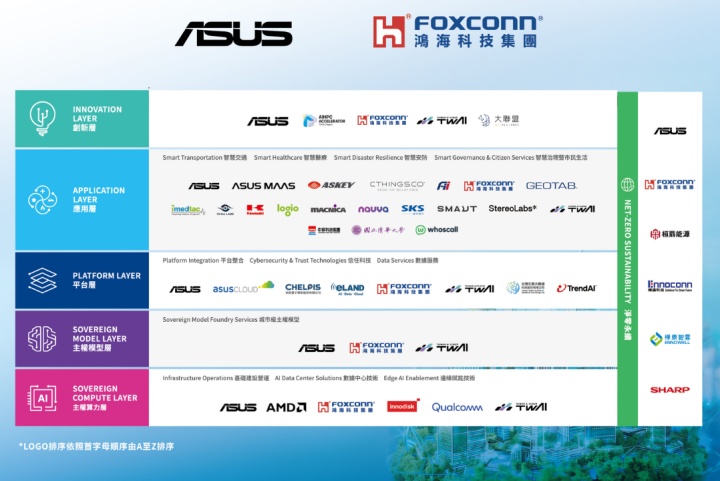
AI City: A Five-Layer Architecture The five-layer AI City architecture encompasses sovereign computing power, sovereign models, platforms, applications, and innovation. Integrated with the broader industrial ecosystem, it outlines a scalable blueprint for the sustainable development of AI-powered cities.
Source: Business Today Taiwan