
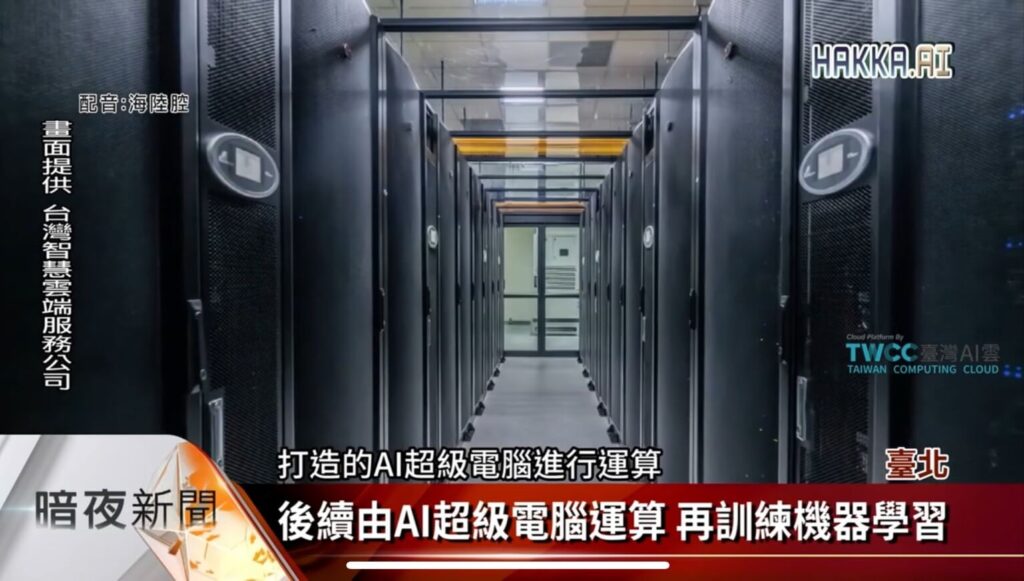
Building a voice database is undoubtedly a major step in language development. The Hakka Affairs Council plans that once the Hakka voice database is completed, it will enable diverse applications of AI, and various sectors expect AI to solve the problem of insufficient manpower in many educational and medical settings. However, scholars point out that there are still many limitations to making the voice database truly usable. For example, when learning a language like Hakka, machines cannot interact as fluently and smoothly as humans. At present, robots cannot accurately recognize non-verbal signals such as facial expressions and gestures, and further breakthroughs are needed.
AI has been developing rapidly in recent years. In the field of education, it can learn languages, conduct digital assessments or translations. In daily life, it can provide smart home services. It can even be applied to medical care in response to the shortage of caregivers in society.
Lee Li-kuo, COO of Taiwan Smart Cloud (Taiwan Smart Cloud): "Many elderly Hakka speakers can use this interface to resolve issues related to medication for long-term care, daily life, and so on. They can get answers to all their questions." By identifying different phrases and inputting Hakka characters, a real human voice immediately appears. The voice database team demonstrated with 20 hours of currently collected speech synthesis content that obtaining Hakka responses is no problem.
Behind the unseen achievement of providing a valid sentence response lies a series of hurdles: inputting phonetic symbols, assigning meaning to them, composing speech and sound signals, and manual verification.
Liao Yuanfu, professor of the Department of Electrical Engineering at Taipei University of Technology: "Recognition is like giving a computer ears, and synthesis is like giving a computer a mouth. So in the future, we hope to create a robot that can listen to Hakka and then have a conversation with you."
The voice library team admitted that, based on the current level of implementation, achieving voice recognition technology is even more difficult than voice synthesis. This is because distinguishing Hakka spoken by people of different ages and accents is an extremely broad range that must be continuously expanded. At the current standard of 300 hours of recording per accent, there is still a long way to go before commercial application.
Professor Liao Yuanfu of the Department of Electrical Engineering at Taipei University of Technology: "In general commercial applications, when they are doing speech recognition, they usually spend tens of thousands or hundreds of thousands of hours. So 300 hours is just a starting point, a seed model that can be made first."
Linguists believe that AI is not only a major breakthrough for language learning, but it can also expand the scope of language use and increase the space for minority languages to survive.
Chiang Wen-yu, professor at the Institute of Linguistics, National Taiwan University: "In the future, our news can actually be transformed into multilingual programs, which will expand the field of language use. This expansion can extend to drama programs and various other programs in different languages."
Taiwan has a diverse ethnic population, and current AI technology is still unable to perform multilingual conversion simultaneously. In fact, it is difficult to preserve the speech and data of relatively disadvantaged languages in society. The uneven collection of samples in remote areas, coupled with the severe digital divide and the behavior and attitudes of users, are all challenges for the application of Hakka AI in the digital age.