
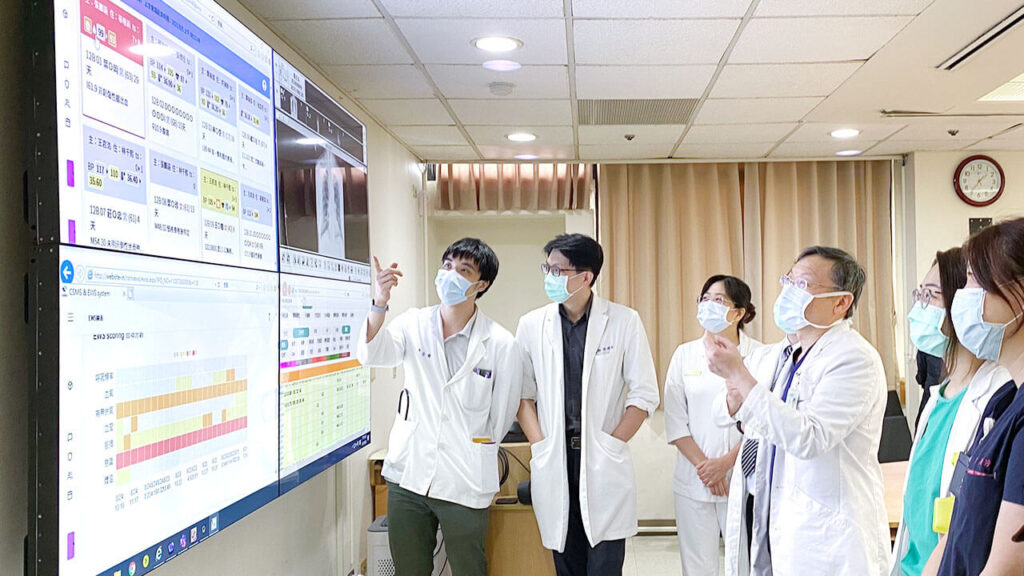
Caption: The Early Warning System (EWS) is a valuable tool for patient care, enabling early detection of disease progression. Healthcare staff can access the EWS system via their mobile phones under their real names, allowing for convenient and rapid monitoring of hospital-wide patient conditions and facilitating quick clinical decision-making. (Ministry of Health Taoyuan Hospital)
Taoyuan is on the front line of national epidemic prevention, and the Ministry of Health and Welfare's Taoyuan Hospital shoulders a heavy responsibility. In addition to providing medical services for epidemic prevention, it also provides medical center-level services to the people of Greater Taoyuan. To improve the service quality of its medical team, the hospital took the lead in using smart medical technology to assist the medical team in caring for patients. During the COVID-19 pandemic, it participated in the "Technology Against the Epidemic 2.0" project launched this year by the National Center for Information Technology and the National Applied Research Laboratories (NARL) in collaboration with TWS (Taiwan Smart Cloud) Co., Ltd. It used the cloud-based smart high-speed computing resources of the TWCC platform to improve the Early Warning System (EWS), reduce the burden on medical staff, and improve the quality of emergency care.
Chen Hou-chuan, Vice Superintendent of Taoyuan Hospital, stated that the hospital's frontline operations are extremely busy. Each medical staff member needs to perform a large number of outpatient services and provide comprehensive care for each patient. The challenges they face are unimaginable to outsiders. Therefore, they actively introduced auxiliary measures from the early clinical warning system originating from the British healthcare system, utilizing big data analysis to extract the essential meaning of data, and using the Line app on smartphones as a messaging platform to implement the mHealth mobile care application.
The hospital has implemented a smart clinical early warning system across its entire facility. Based on patients' physiological measurements, this system detects changes in patients' conditions (clinical deterioration) early and allocates critical care resources immediately to reduce patient harm. It also improves the quality of medical care, reduces medical disputes, effectively manages the clinical medical team, and reduces the hospital's cost burden. Especially in the era of artificial intelligence (AI) and big data analytics, by downloading historical medication information from the National Health Insurance cloud and conducting big data analysis of the National Health Insurance database, multiple comorbidity indices are constructed as a treatment risk assessment. This allows the Early Warning System (EWS) to proactively and promptly alert staff when patients' physiological signs worsen, improving the efficiency and accuracy of clinical medical staff.
Based on multiple comorbidity indicators of patients, an optimized interdisciplinary care team is formed to provide precise care, which not only achieves the best treatment results but also avoids potential complications. Currently, EWS proactively identifies key patients from patient data, focusing the team's attention on high-risk patients. Medical care is concentrated on high-risk patients, and the data is made transparent through the mobile phones of medical staff, with different colors used to mark warnings and prompts for high-risk patients on the mobile phones, so as to quickly identify the patient's condition.
Chen Houquan recalled that the first three months after the system's implementation were the first challenge. Colleagues had different suggestions regarding the system's integration, including the completeness of data presentation and even the color system. Once the colleagues were familiar with the information, doctors could directly view the physiological information of their patients through the EWS interface, thus gaining a proactive understanding of their conditions and shifting from a passive to an active approach.
Hoping to use AI to select high-risk patients, Taoyuan Hospital, under the Ministry of Health, began collaborating with a team from the Department of Life Sciences at National Yang-Ming University in 2020. Assisted by TWCC computing resources and the professional services of the National Center for Information Technology and Taiwan Smart Cloud (TWS), the entire system underwent over a year and a half of refinement and testing. It is used to manage high-risk patients with a 5+% risk profile. From the initial implementation, the hospital...The daily one-hour EWS meeting has been shortened to a mere 10 minutes, allowing for a quick overview and understanding of the condition of 300 patients.The approach has shifted from checking every room to focusing on key rooms, successfully saving manpower and time.
Through the intervention of EWS (Emergency Response System), Ministry of Health Taoyuan Hospital not only reduces the number of unexpected emergency calls through its real-time early warning function, but also responds more promptly and accelerates rescue time, thereby improving the post-emergency ward mortality rate. Through this intelligent solution,On average, it improves the unexpected emergency care rate by approximately 31 per % per year and improves the ward mortality rate after emergency care by an average of 50 per %.They have achieved remarkable results in saving patients' precious lives.
The hospital's EWS project team regularly tracks, discusses, and analyzes system usage to improve healthcare utilization. Notably, some experienced medical staff can accurately identify high-risk patients through professional intuition, such as certain patients' physiological characteristics or information. Chen Houquan believes this is a valuable early warning mechanism for the future. By linking scientific facts, the accuracy of the early warning system can be systematically enhanced, further accelerating rescue time.
Looking ahead, Ministry of Health Taoyuan Hospital will continue to promote cloud-based deployment. Through the strategy of cloud-based medical information systems, body temperature measurement and heart rate information will be uploaded to the cloud to provide a shared mechanism across hospitals. The system will also be gradually expanded to the 26 hospitals under the Ministry of Health in Taiwan. It is hoped that a set of standards for medical staff to jointly care for patients will be established with EWS as the core, continuously improving the quality of emergency care, maintaining patient safety, implementing the principles of real-time early warning and early response, and strengthening the chances of saving lives.
Source:National High-Speed Network and Computing Center, National Research Institute