
The 2025 AIHPCcon supercomputing conference continued the theme of "Driving AI Development with Computing Power". The morning session was hosted by Taiwan AI Cloud and the Administration for Digital Industries, moda. It was the final event of this year's "AI International Technology Day" series, focusing on computing power infrastructure, model performance and urban applications, echoing the implementation of the new ten major construction projects for AI.
The afternoon session, co-hosted by Taiwan AI Cloud and the Tainan City Government, was themed "AI City," showcasing city-level AI initiatives. Through keynote speeches and the forum "AI City: Building a City-Level AI Innovation Ecosystem," the session comprehensively demonstrated Taiwan's strengths in AI computing power, model training, and AI Foundry, further empowering cross-domain integration of cities and ecosystems, accelerating the implementation of applications in transportation, healthcare, disaster prevention, and other fields, and forming a replicable and exportable Taiwanese AI development model.
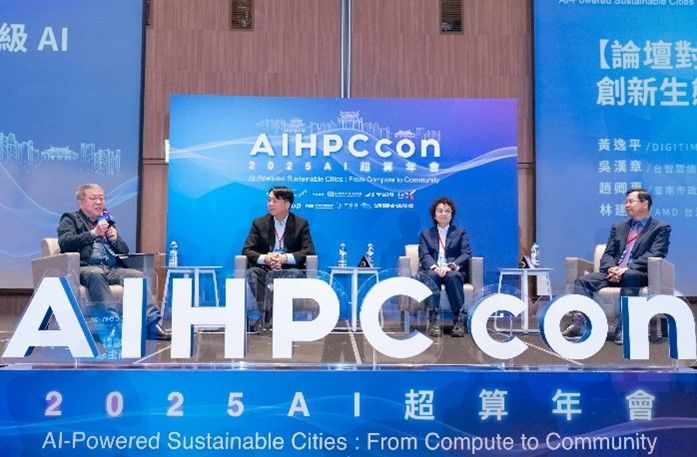
The closing forum, "AI City: Building a City-Level AI Innovation Ecosystem," was moderated by Huang Yiping, Vice General Manager of DIGITIMES, who engaged in in-depth discussions with Peter Wu, Zhao Qinghui, and Lin Jiancheng. Huang Yiping pointed out that AI has evolved from text-based to multimodal and agentic AI, leading urban governance into a new stage of comprehensive empowerment.
Peter Wu explained Taiwan AI Cloud's dual-core strategy: First, to promote the popularization of AI computing power, enabling domain experts to quickly develop diverse applications through No-Code/Low-Code tools, thereby popularizing AI knowledge and accelerating industrial transformation; second, to establish AI operation security standards, covering intelligent workload allocation, flexible computing power expansion, and model trustworthiness, creating a highly efficient and reliable AI service system. He emphasized that these two strategies complement each other, enabling Taiwan AI Cloud to play a key role in computing power supply, model services, and ecosystem integration, not only providing the technological foundation but also assisting industries and governments in establishing a complete path from digital transformation to net-zero sustainability through cross-domain innovation.
Zhao Qinghui added that AI-driven smart transportation has substantially improved the citizen experience, shortened parking space search time, and cumulatively reduced carbon emissions by 993 metric tons. The city government has also improved talent support in education, housing, and entrepreneurship through K12 Shalun International High School and the Winning Land Innovation Incubation Base. Lin Jiancheng pointed out that AI City will move towards a distributed computing architecture: the city government will build high-performance GPU servers; departments and bureaus will introduce Edge Servers and Edge Devices; and grassroots communities will introduce AI PCs to balance data sensitivity, reduce latency, improve energy efficiency, and promote governance participation.
Huang Yiping concluded that Taiwan can serve as a pioneer in AI City, exporting its successful experience to the adoption market and focusing on vertical AI, deepening its application in areas of expertise to create long-term benefits.