BLOG

Wu Hanzhang: NVIDIA AI Summit: Seeing the Future of Healthcare

NVIDIA showcased several medical AI innovations at its technology conference, driving the intelligentization of healthcare. The BioNeMo platform helps accelerate drug development and clinical trials, while the Evo 2 biological model can predict genetic mutations, facilitating personalized medicine. NVIDIA also collaborated with GE HealthCare and Hyperfine to integrate AI into X-rays, ultrasound, and portable MRI, improving diagnostic efficiency and accessibility. In the surgical field, the Isaac platform supports Virtual Incision and Moon Surgical in developing AI-assisted surgical robots, enhancing surgical precision and responsiveness. Experts called for greater attention to AI ethics and patient privacy.

Wu Hanzhang: NVIDIA AI Summit: Seeing the Future of Healthcare 閱讀全文 »

Wu Hanzhang: DeepSeek Brings New Opportunities to Medical AI

In recent years, AI has developed rapidly in the medical field, but high costs and data privacy issues have limited its widespread adoption. DeepSeek, as an open-source large-scale language model, possesses powerful capabilities that can be applied to medical literature analysis, medical record summarization, and more, and supports local deployment, lowering the barrier to AI development and ensuring data security. For Taiwan, DeepSeek provides an opportunity to develop medical AI, promoting the construction of localized medical models and ecosystems. Its open-source model breaks the monopoly of closed AI, promotes the popularization of medical AI, and brings more possibilities for future medical innovation.

Wu Hanzhang: DeepSeek Brings New Opportunities to Medical AI 閱讀全文 »

Wu Hanzhang: A Wise Partner in the New Era of Healthcare

The 2024 Medicaid Expo focused on AI, highlighting the rise of AI Agents and their revolutionary potential in healthcare. AI Agents can autonomously perform tasks ranging from 24-hour health consultations and medical image analysis to drug development and personalized treatment. They effectively address issues such as uneven distribution of medical resources and diagnostic errors, driving progress in smart healthcare. However, challenges such as data privacy, algorithmic bias, and accountability need to be addressed. In the future, AI Agents will possess stronger multimodal interaction and self-learning capabilities, becoming crucial assistants to healthcare professionals and improving human health and well-being.

Wu Hanzhang: A Wise Partner in the New Era of Healthcare 閱讀全文 »

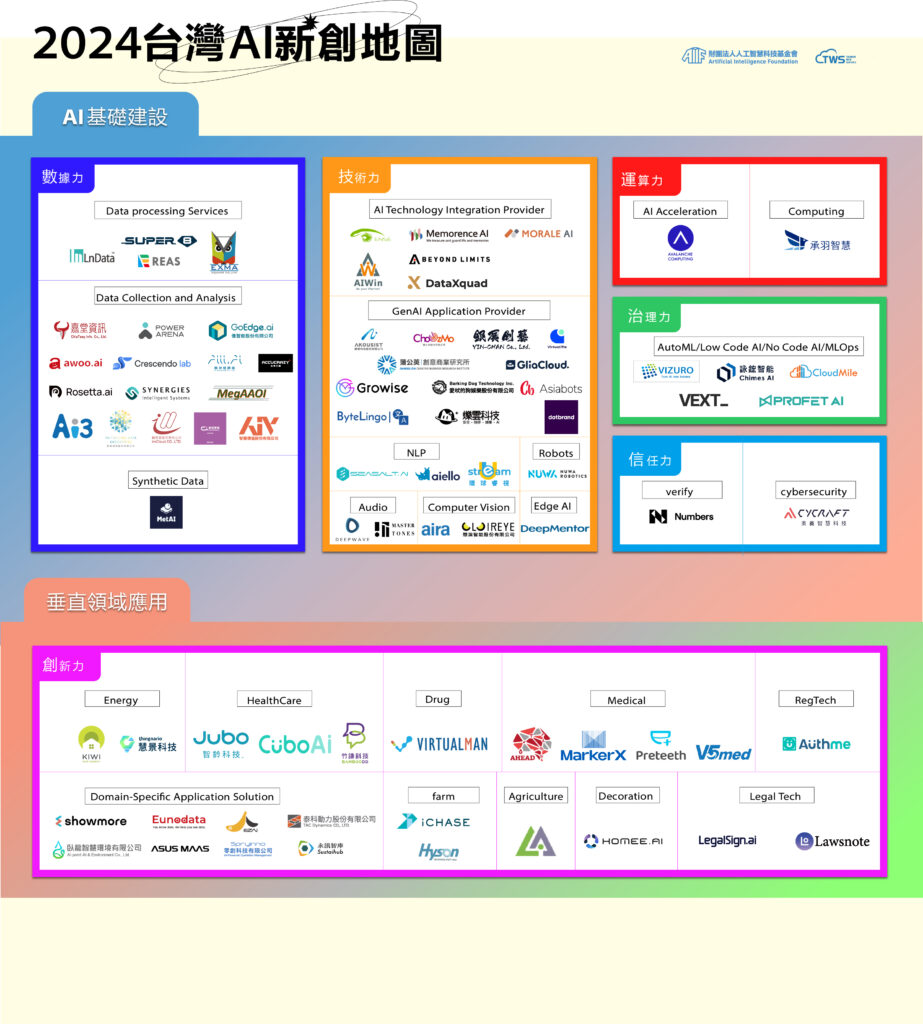
Taiwan's AI Startup Map 2024

2024 Taiwan AI Startup Map Released: Practical Applications and AI Agents are Key Focuses (Part Two)

In this era of data explosion, predictive analytics has become an indispensable tool across all industries. By uncovering valuable information hidden within historical data, businesses can predict critical issues such as customer churn and equipment failures, and take corresponding countermeasures to significantly improve operational efficiency. However, traditional predictive analytics technologies face numerous challenges, such as: complex model construction processes, extensive experimentation in algorithm selection and model training, excessive data dimensions, diverse data formats and sources, and a shortage of specialized talent. This presents an exciting application prospect for emerging technologies like Predictive GenAI (Predictive Generative Artificial Intelligence).

2024 Taiwan AI Startup Map Released: Practical Applications and AI Agents are Key Focuses (Part Two) 閱讀全文 »

2024 Taiwan AI Startup Map Released: Practical Applications and AI Agents Will Be the Focus of Observation

2024 Taiwan AI Startup Map Released: Practical Applications and AI Agents Will Be the Focus of Observation (Part 1)

In this era of data explosion, predictive analytics has become an indispensable tool across all industries. By uncovering valuable information hidden within historical data, businesses can predict critical issues such as customer churn and equipment failures, and take corresponding countermeasures to significantly improve operational efficiency. However, traditional predictive analytics technologies face numerous challenges, such as: complex model construction processes, extensive experimentation in algorithm selection and model training, excessive data dimensions, diverse data formats and sources, and a shortage of specialized talent. This presents an exciting application prospect for emerging technologies like Predictive GenAI (Predictive Generative Artificial Intelligence).

2024 Taiwan AI Startup Map Released: Practical Applications and AI Agents Will Be the Focus of Observation (Part 1) 閱讀全文 »

Wu Hanzhang: A World-Class Medical Event in Taiwan

Taiwan will host the World Congress on Medical and Health Information next August, showcasing its globally leading capabilities in medical information and AI applications. This international event will bring together experts from around the world, focusing on innovative AI applications in national health insurance, healthcare, and long-term care, and demonstrating Taiwan's medical information systems, electronic medical records, and telemedicine technologies. Taiwan's healthcare system ranks among the most efficient and high-quality globally; this congress will solidify its leading position, demonstrate its innovative strength in AI within healthcare, and enhance Taiwan's influence in the international medical technology community!

Wu Hanzhang: A World-Class Medical Event in Taiwan 閱讀全文 »

Wu Hanzhang: Core Competencies in Smart Medical Devices Lie in Taiwan

Taiwan possesses advantages for developing the smart medical device industry, including world-class ICT capabilities, a well-developed healthcare system and talent pool, and the innovative flexibility of SMEs. Furthermore, the increasing demand from an aging society presents a huge market potential for smart medical devices. However, the smart medical device industry faces the challenge of long investment recovery periods, requiring government support through capital market linkages, such as dedicated funds, tax incentives, industrial parks, and expedited review processes. Simultaneously, reforming the medical insurance system is crucial to expanding market demand for smart medical devices, enhancing international competitiveness, and promoting economic transformation.

Wu Hanzhang: Core Competencies in Smart Medical Devices Lie in Taiwan 閱讀全文 »

Wu Hanzhang: Elderly care hides a goldmine of AI

Taiwan possesses strong medical resources and technological capabilities, and should actively utilize AI technology to address elderly care issues, particularly mental health and social needs. The combination of generative AI, voice recognition, and robotics can provide 24/7 companionship for the elderly, improving the efficiency and quality of care. With the advent of a super-aged society, Taiwan can occupy a leading position in global elderly care innovation, achieving a win-win situation for both economic benefits and social responsibility.

Wu Hanzhang: Elderly care hides a goldmine of AI 閱讀全文 »

Wu Hanzhang: The Key to Sustainable Healthcare

The healthcare industry faces challenges such as labor shortages, digital security, resource scarcity, and climate change. According to the World Economic Forum and The Lancet, the carbon footprint and privacy issues in the healthcare industry are becoming increasingly serious. Digital technologies such as telemedicine, blockchain, and big data can effectively address these problems, improving accessibility to healthcare services, reducing costs, and decreasing the carbon footprint. As the importance of digital transformation and sustainability grows, the digitization of healthcare should be accelerated to ensure timely and affordable healthcare services.

Wu Hanzhang: The Key to Sustainable Healthcare 閱讀全文 »

Wu Hanzhang: Highlights of Taiwan's Advanced Smart Medical Devices

Portable ultrasound technology offers unique advantages in medical diagnostics, making it an indispensable part of modern medicine. Its compact size and reasonable price facilitate real-time testing in various settings, leading to its widespread application in emergency care, clinical diagnosis, and mobile healthcare. Taiwanese electronics companies such as Compal and ASUS are leveraging their core technologies to cultivate this field, launching products compliant with TFDA/FDA standards and competing with world-class products in the market. The introduction of AI technology can accelerate testing, improve the accuracy of image analysis, and provide more comprehensive patient information, assisting in medical decision-making. Taiwanese companies are integrating AI into ultrasound equipment to achieve intelligent analysis, automated testing, and personalized treatment, further enhancing its practicality and value.

Wu Hanzhang: Highlights of Taiwan's Advanced Smart Medical Devices 閱讀全文 »

Generative AI empowers Predictive GenAI, enabling businesses to gain new insights and predict the future, and revitalize data to enhance business intelligence decision-making!

In this era of data explosion, predictive analytics has become an indispensable tool across all industries. By uncovering valuable information hidden within historical data, businesses can predict critical issues such as customer churn and equipment failures, and take corresponding countermeasures to significantly improve operational efficiency. However, traditional predictive analytics technologies face numerous challenges, such as: complex model construction processes, extensive experimentation in algorithm selection and model training, excessive data dimensions, diverse data formats and sources, and a shortage of specialized talent. This presents an exciting application prospect for emerging technologies like Predictive GenAI (Predictive Generative Artificial Intelligence).

Generative AI empowers Predictive GenAI, enabling businesses to gain new insights and predict the future, and revitalize data to enhance business intelligence decision-making! 閱讀全文 »

Wu Hanzhang: The smart healthcare industry can take the lead.

Taiwan's smart healthcare industry has become a nationwide phenomenon, with hospitals at all levels actively pursuing smart technology, and the industry viewing medical technology as a crucial area of innovation. The government has introduced smart healthcare policies, and the capital market has seen the emergence of listed smart healthcare companies. However, it faces challenges such as a limited market, insufficient payment flexibility, and oversupply. The pandemic has increased consensus on smart healthcare, providing an opportunity to address core issues, such as increasing the proportion of healthcare in GDP. The challenges facing the smart healthcare industry are similar to those of other industries' digitalization development, but it should leverage its high level of consensus and abundant human resources to quickly develop solutions and find the right path for Taiwan to develop into a digital and artificial intelligence nation.

Wu Hanzhang: The smart healthcare industry can take the lead. 閱讀全文 »

EDM Subscription

EDM Subscription

On-Demand AI Cloud Consulting

Business Consulting
Sales Contact Form