
▲ The Artificial Intelligence Foundation (AIF) and Taizhiyun AI Supercomputing Accelerator collaborated to release the "Taiwan's AI Startup Map 2025". It can be observed that many applications on the market simply connect to large model APIs and optimize the interface. While these allow business owners to quickly experience the convenience of AI tools, these products, lacking domain know-how, often fail to deeply integrate with enterprise workflows and thus struggle to solve real pain points. How to sift through the hype and identify technologies with genuine implementation capabilities will be the focus of market attention in the coming year.
The Artificial Intelligence Foundation (AIF), in collaboration with Taizhiyun AI Supercomputing Accelerator, released the "Taiwan's AI Startup Map 2025" on December 8th. This map primarily includes startups established within the last eight years, evaluating them based on three core criteria: value, mastery, and importance. The map aims to outline the development trends of AI startups in Taiwan by 2025 and provide guidance for companies seeking transformation partners.
Beyond discovering promising newcomers, we also value the industry's foundation. Taiwan's AI ecosystem has developed to a point where it boasts a group of well-established and stable companies. Although these companies are not included in this startup map due to inclusion criteria (such as years of establishment), their technical capabilities are undeniable. AIF will continue to compile relevant lists to ensure that companies seeking transformation partners have the most comprehensive selection.
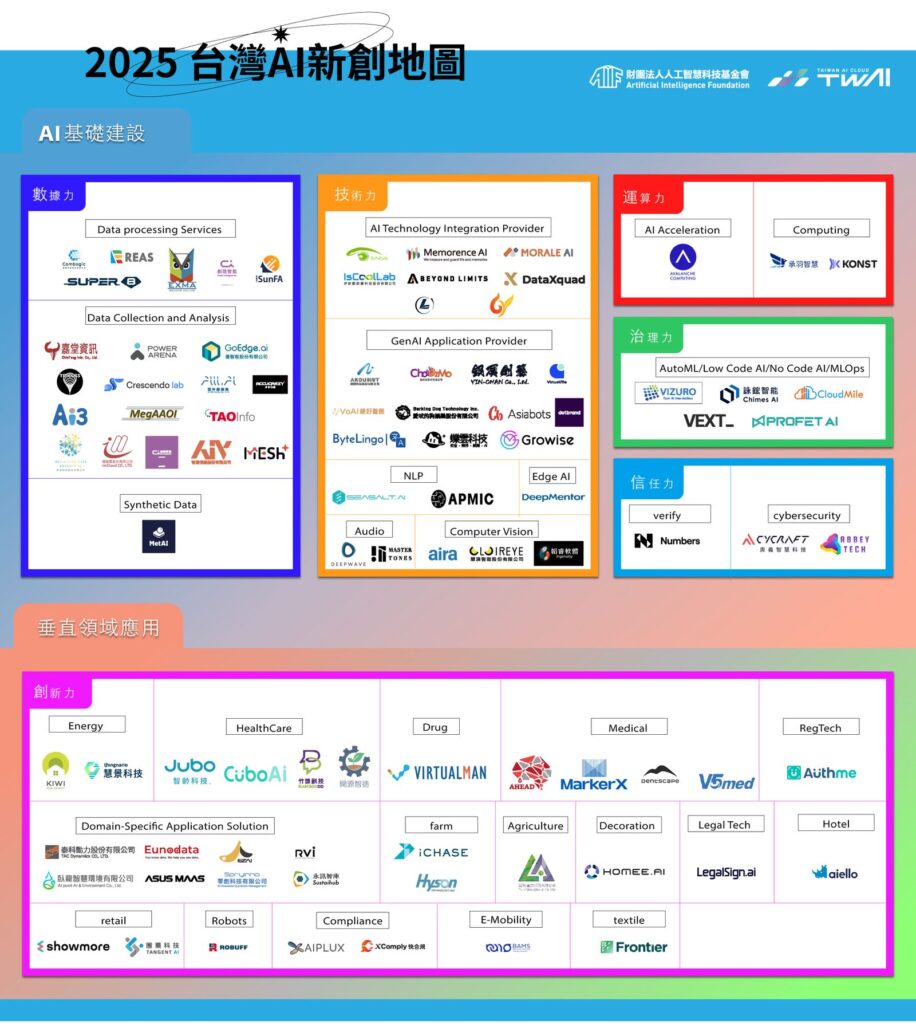 ▲ 2025 AI Startup Map
2025 AI Startup Development Trends: From Projects to Products
Since 2023, generative AI has swept the globe, with various technological iterations and application tools emerging like mushrooms after rain. However, the bustling supply side has not directly translated into practical application on the demand side. According to the "2025 Taiwan Industrial AI Survey," about 70% of enterprises are still at the initial stage of understanding AI, indicating that the speed of technological evolution is much faster than the enterprises' ability to absorb it.
Despite the slow pace of adoption, enterprises' "AI anxiety" has not subsided, which seems to have also influenced the development direction of the startup community. Because generative AI has significantly lowered the development threshold, even startups lacking core technological expertise can quickly enter the market. Consequently, many applications have emerged that merely connect to large model APIs and optimize interfaces. While these allow business owners to quickly experience the convenience of AI tools, these products, lacking domain know-how, often fail to deeply integrate with enterprise workflows and thus struggle to solve real pain points. How to sift through the hype and identify technologies with genuine implementation capabilities will be the focus of market attention in the coming year.
Compared to the past when startups relied heavily on customized project services to accumulate industry experience, in recent years we have observed a significant transformation trend. More teams are actively cultivating vertical industries and gradually transforming this experience into standardized products. The emergence of generative AI plays a crucial communication role, effectively overcoming software operation barriers for non-technical personnel through conversational interaction, significantly reducing the learning curve and adoption threshold for enterprises.
It is worth noting that we observed two key trends in this list:
Advantages of domain experts:
Entrepreneurs with strong industry backgrounds are often better able to pinpoint pain points. They have a more refined understanding of workflows and can clearly identify which stages are most suitable for AI intervention, thereby developing products that better meet industry needs. For example, Danone Information, a catering AI service brand incubated within the leading Taiwanese agricultural and food industry group, Dachen Group, leverages its extensive operational data and on-site experience accumulated across farming, processing, and catering to gradually optimize production, distribution, and decision-making processes through AI systems. It aims to solve pain points faced by Taiwanese SMEs and the catering and retail industries, such as food inventory management, waste control, and cumbersome ordering processes.
Multiplication of existing assets:
Meanwhile, startups with existing technological foundations and data resources have demonstrated greater adaptability in the face of the new wave of generative technologies. They can more quickly integrate GenAI technology into their existing mature product architectures and leverage years of accumulated industry data to strengthen their product advantages, creating a technological moat that is difficult for competitors to replicate.
Amidst the cacophony of voices, we have selected three Stars of the Year, each representing a different aspect of the development of AI startups in Taiwan.
Hardware and software integration to build a technological moat: Rayleigh Vision Intelligence (RVi)
Rayleigh Optoelectronics focuses on empowering Micro LED intelligent manufacturing with AI and is a key practitioner in realizing "AI-assisted large-scale optical component transfer". The team's greatest feature is its "combination of software and hardware strengths". The founder combines academic innovation with industry practice, and the team has an equal ratio of software and hardware R&D personnel, which provides a solid foundation for the implementation of its technology.
While Micro LED is considered the next-generation display technology leader, the "mass transfer" process, involving millions of microchips, is extremely challenging. Traditional processes are time-consuming and have inconsistent yields, becoming the biggest bottleneck for mass production. RVi utilizes its proprietary AI algorithm to precisely solve three major challenges: "chip defect screening," "damage during mass transfer," and "chip repair after transfer." By significantly improving process yield and efficiency, RVi aims to accelerate the transition of Micro LED from the laboratory to large-scale mass production.
Leveraging technology to drive innovative applications: Sunshine Intelligent Accounting
iSunFA.com is an innovative cloud-based accounting platform dedicated to reshaping corporate financial processes using AI technology. It not only assists businesses and individuals in automating tedious accounting tasks, but also serves as a smart matchmaking hub connecting businesses with professional bookkeepers and accountants.
The platform uses a homomorphic encryption architecture to generate real-time reports and combines blockchain and zero-knowledge proof technologies to establish a highly trustworthy system with privacy protection and immutability. Through this mechanism, auditing can be completed without relying on third-party intermediaries or disclosing the original data content, significantly improving auditing efficiency, trust level, and anti-counterfeiting capabilities, laying a solid foundation for continuous auditing and intelligent compliance.
Breaking down information silos and building a key bridge for AI implementation: IsCoolLab Software
Founded in 2018, the company focuses on industrial-grade robotic process automation (RPA), actively integrates AI technology into its solutions, and has launched Robotiive, a process automation platform that integrates artificial intelligence and computer vision patented technologies.
Many enterprises, during their digital transformation, often struggle to truly implement AI applications due to cumbersome internal processes or a backlog of legacy systems. The Robotiive platform, with its "non-intrusive deployment" capability, enables cross-system and cross-device data integration and operational automation without requiring modifications to existing code. It helps enterprises quickly connect existing systems, effectively breaking down information silos, and has become a crucial technology partner for industries such as manufacturing and finance in achieving automation transformation and implementing AI applications.
At the same time, we have also observed several key points and trends that are worth sharing with businesses and startup partners:
I. The Rise and Hidden Concerns of Agentic AI:
Currently, many emerging AI applications are still at the stage of "RAG (Retrieval Enhancement Generation) + Chat," at best only capable of reading information. For these products that only have chatbot functionality, the key differentiator in terms of product value lies in whether they can connect to APIs to allow AI to actually "execute tasks." To achieve this, the core lies in whether the development team possesses deep domain knowledge to accurately identify workflows that can be automated.
On the other hand, granting AI "action" and "autonomy" is a double-edged sword. The current market's excessive hype and blurred understanding of AI agents are bringing serious cybersecurity challenges to enterprises. Many enterprises are rashly implementing AI agents before clarifying the difference between "automation tools" and "autonomous intelligent agents," which may lead to risks such as over-authorization, unpredictable autonomous behavior, and new vulnerabilities for supply chain attacks. For example, when an enterprise relies on an "all-in-one" platform to connect all core systems, once the platform is compromised, attackers can use the privileges already obtained by the agent to gain unimpeded access to the enterprise's critical systems, creating attacks that are difficult to defend against.
II. Integrating hardware and software to develop vertical industry applications (e.g., robots)
Software and hardware will be more tightly integrated, with a focus on the development of vertical industry applications. For example, robotics, which has been the subject of much discussion recently, is a field with great potential for development. Its applications have expanded from traditional factories to diverse fields, such as meat-cutting robots for automated food processing, surgical robots for high-precision surgery in the medical field, and home robots. Because these applications involve complex linkages of sensing, computing, and mechanical control, and because the levels involved are very complex, they not only present technical challenges but also require cross-disciplinary collaboration between industry, government, and academia to jointly build a development blueprint for software and hardware integration.
For Taiwanese startups, it's difficult for them to compete with Silicon Valley giants (such as OpenAI and Google) in the pure software and general-purpose big model races. However, we have a unique advantage in that we have many talents and key hardware capabilities that combine expertise in AI software, domain know-how, and the ability to integrate edge hardware.
Facing a large number of SMEs and manufacturing plants in Asia, customers generally have cybersecurity concerns about "reluctance to migrate data to the cloud" and prefer "one-time purchase" rather than long-term subscription (SaaS) procurement habits. Therefore, developing AI applications with exclusive data processing capabilities that can "run offline" in Edge form will be the breakthrough path for Taiwanese startups.
Third, the need for cloud-ground integration is becoming increasingly apparent, and edge computing is becoming more and more important.
The growing need for cloud-edge computing integration makes edge computing increasingly important for Taiwanese industries. The maturity of Edge AI and Small Language Models (SLMs) presents new opportunities for these industries. On-device chips and AI not only enable real-time prediction and response but also data capture. From a vertical industry perspective, edge computing can help alleviate Taiwan's relatively scarce data resources.
Due to the rigid requirements of Taiwan's manufacturing and healthcare industries for cybersecurity and low latency, many enterprises have a strong demand for "on-premise" deployment. As many Small Models (SLMs) are increasingly approaching the GPT-3.5 level, the hardware barriers and costs for enterprises to run highly intelligent AI locally have been significantly reduced.
The market winners of the future will no longer be large-scale manufacturers pursuing universal, all-encompassing solutions, but rather those who can leverage Taiwan's robust hardware supply chain to launch integrated hardware and software solutions. Examples include AI-powered "defect detection kits" or "offline legal/medical assistants." This "offline-available" model, compared to endless pure software subscriptions (SaaS), is more appealing to Taiwan's traditional industries and SMEs, addressing their concerns about cloud security and long-term subscription fees.
IV. Simultaneous Development of Open Source and Closed Source Models: The Synergistic Effect of LLM and SLM
While the core technology of very large language models (LLMs) is currently dominated by US tech giants, small language models (SLMs) are showing tremendous potential for breakthrough in practical applications across vertical industries. Compared to general-purpose large models, SLMs can provide immediate and precise processing for specific workflows, making them a pragmatic choice for enterprises to solve specific problems.
However, to maximize this synergy, enterprises cannot focus solely on the model itself; they must also rethink their infrastructure to integrate cloud computing power with a hybrid architecture at the edge, aiming to achieve the best balance between cost, performance, and privacy.
V. AI applications require specific scenarios, emphasizing ecological collaboration within urban environments.
AI applications need specific scenarios to be implemented. The future development trend will shift from general-purpose technologies to focused vertical fields, with cities becoming the best testing ground for ecosystem collaboration. Through the concrete scenarios of AI Cities, the integration of hardware and software will no longer be aimless, but will precisely solve real-world problems, accelerating the practical application of technology. This wave of ecosystem collaboration 'with cities as the field' is precisely the core trend that AI Map will focus on next year.
At the heart of these trends is a greater emphasis on application and vertical integration. Furthermore, domain experts with deep industry backgrounds and startups with accumulated technological expertise can integrate new technologies into existing product architectures, leveraging years of accumulated industry data and knowledge to build a difficult-to-replicate "moat," giving them stronger integration capabilities in the rapidly changing AI era.
Remark:
Value proposition: The product or service can create new value for businesses or industries, such as new business models.
Mastery: This includes mastery of both technology and information.
Importance: The importance of this product or service to the enterprise or industry (whether it solves a major pain point).
[Source:]Know the situation】