
At the recently concluded Nvidia Technology Conference, Nvidia showcased its innovative artificial intelligence (AI) technologies for the healthcare field. These groundbreaking technologies are accelerating the healthcare industry into a new era of intelligence, with profound impacts on everything from diagnosis and treatment to patient care.
In drug development and clinical trials, Nvidia launched BioNeMo, an AI platform specifically designed for life sciences. This system integrates pre-trained models and generative AI tools to help researchers more efficiently perform molecular modeling, predict interactions between drugs and targets, and improve the accuracy and speed of patient recruitment in clinical trials. Meanwhile, Nvidia's collaboration with the Arc Institute to develop Evo 2 has created the world's largest biological basis model. Using over 9.3 trillion nucleotides of training data, it can accurately predict disease-related gene variations and simulate the design and synthesis of new genomes, opening a new chapter for personalized medicine.
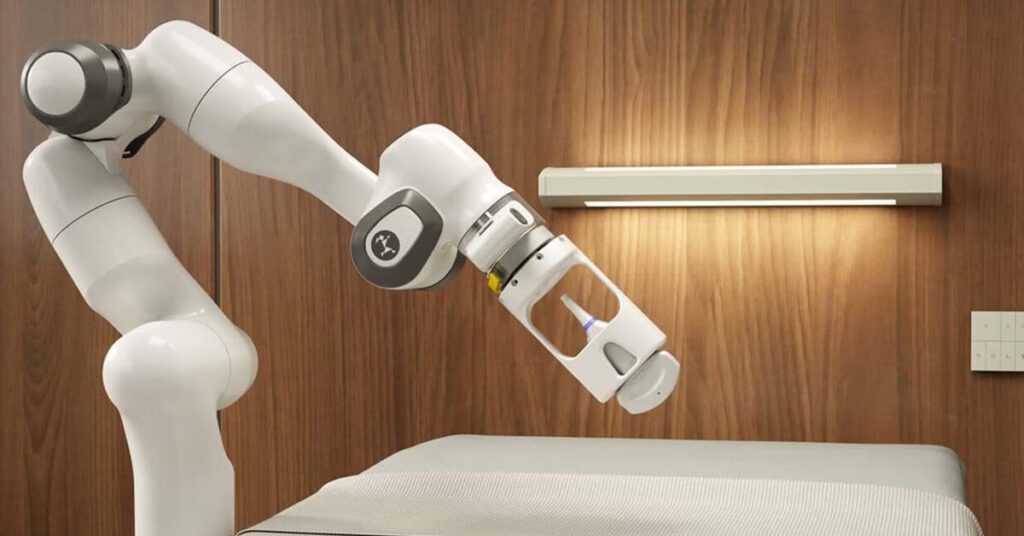
The medical imaging field has also entered the era of AI automation. NVIDIA and GE HealthCare have expanded their collaboration to develop automated X-ray and ultrasound systems using AI technology, providing a solution to the shortage of radiology staff. These systems can automate repetitive tasks and even interact with patients, significantly improving the efficiency and accuracy of imaging diagnosis. Furthermore, Hyperfine and NVIDIA have partnered to apply AI technology to portable MRI (magnetic resonance imaging), making advanced brain scans faster and more cost-effective, thus advancing global healthcare accessibility.
Another hot topic is the revolutionary application of AI robotics in surgery. Virtual Incision is using NVIDIA's Isaac for Healthcare platform to create a new generation of intelligent surgical robots, aiming to enhance surgical precision and safety. Meanwhile, Moon Surgical's Maestro surgical robot recently received FDA approval in the United States and integrates NVIDIA's AI technology, enabling it to provide real-time perception and decision support, thus enhancing its intelligent responsiveness in the surgical field.
However, the rapid development of AI in the medical field is also accompanied by potential risks. While large-scale models can provide highly accurate disease predictions and treatment recommendations for personalized medicine, issues such as data privacy and algorithmic bias have also attracted attention. Experts are calling for the establishment of sound ethical standards and regulatory mechanisms to ensure that the application of AI technology is fair and just, and to effectively protect patients' rights. AI is changing the industry landscape at an unprecedented pace. With technological evolution and deepening applications, future healthcare will be more personalized, efficient, and accessible, bringing more accurate and intelligent health care experiences to patients worldwide.
Source: Financial News Issue 735